
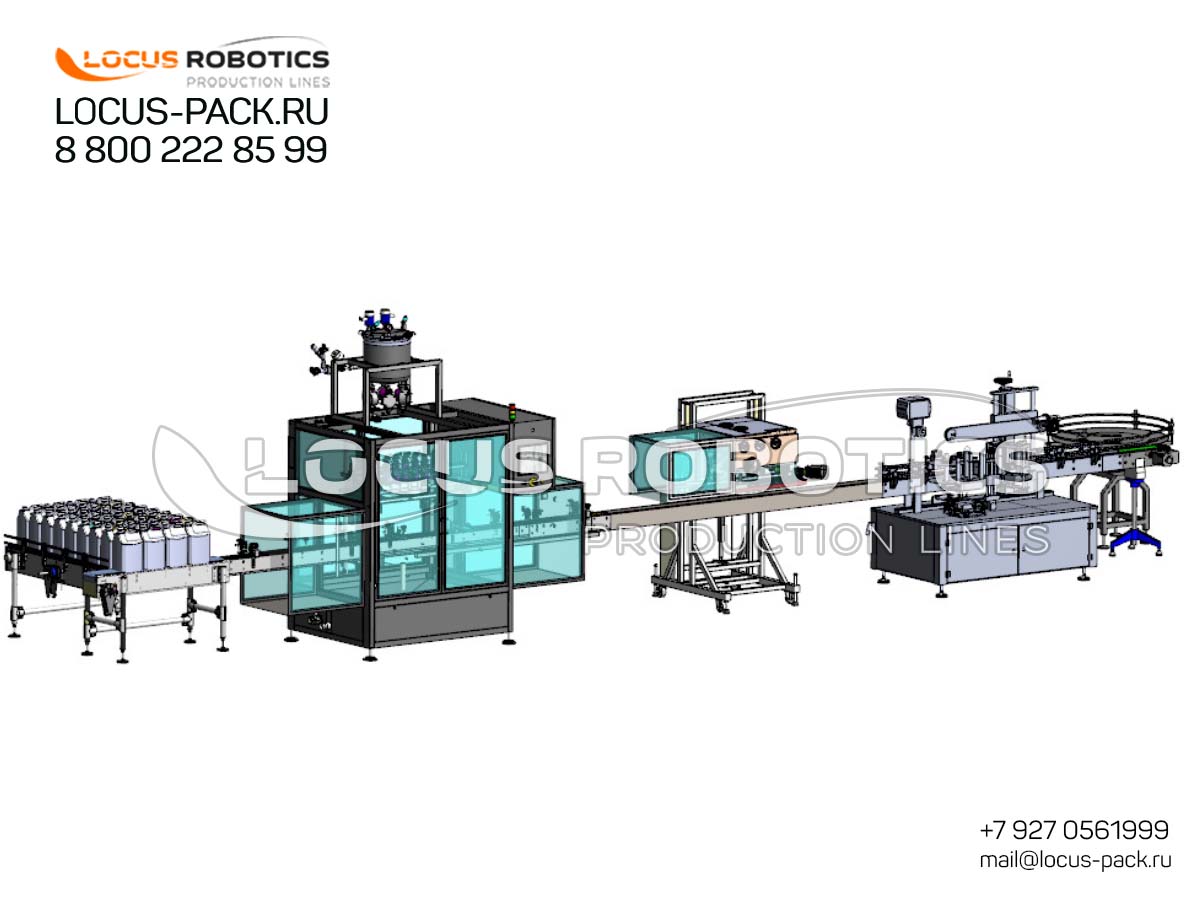
Description
R-300 Complex: Automatic Filling, Capping & Labeling Line for Agrochemicals and Flammable Liquids (5-20L Jerrycans)
Specialized Packaging for High-Risk Agrochemicals and Solvents
The packaging of toxic agrochemicals and flammable liquids imposes the highest standards of accuracy, safety, and containment. A single error in dosing or sealing can have serious consequences for product efficacy, user safety, and regulatory compliance. This R-300 Complex is not a general-purpose line; it is a specialized engineering solution designed from the ground up to manage these high-risk products. It automates the complete packaging process for 5-20L jerrycans, ensuring precise fills, hermetic seals, and compliant labeling while systematically minimizing hazards. For manufacturers of crop protection agents, industrial solvents, and other flammable or toxic chemicals, this line provides the critical combination of technological precision and built-in safety architecture necessary for responsible and efficient production.
Technical Configuration for Demanding Formulations
The line is configured as a sequential, automated system designed to maintain control and integrity throughout the packaging process.
-
Container Handling & Precision Electromagnetic Filling
The process begins with an Accumulating Distributor Conveyor that organizes and feeds empty jerrycans. They are transported to the core Electromagnetic Flow Meter (EMF) Filling Block. EMF technology is ideal for conductive liquid agrochemicals and water-based formulations, offering high accuracy without moving parts in the flow path, which ensures durability and easy cleaning. The system is designed to manage challenging product characteristics like high viscosity and foaming, maintaining consistent fill volumes crucial for accurate active ingredient dosing. -
Through-Type Capping & Flat-Surface Labeling
After filling, containers move to a Through-Type Capping Station. This system applies screw caps with consistent, controlled torque to create a reliable, leak-proof seal essential for preventing hazardous material release. Finally, a Flat-Surface Labeling Line applies labels specifically designed for the flat panels of jerrycans. This ensures clear, durable application of critical information, including hazard symbols, instructions for use, and regulatory text compliant with GHS (Globally Harmonized System) and local market requirements. Finished containers are collected on a Disc Accumulation Table for easy palletizing.
Target Products & Hazardous Material Applications
This line is explicitly designed for hazardous and regulated liquid products:
-
Agrochemicals & Pesticides: Liquid herbicides, insecticides, fungicides, nematicides, and other crop protection agents.
-
Flammable Liquids (LFLs): Industrial solvents, alcohols, acetone, toluene, certain thinners, and other flammable chemical preparations.
-
Toxic & Aggressive Chemicals: Concentrated acids, biocides, and other hazardous formulations requiring secure packaging.
Critical Safety Features and Hazard Mitigation
-
Hazard-Specific Design: The line’s construction and optional features (like ATEX-rated components for explosive atmospheres) are selected to mitigate risks specific to flammability and toxicity.
-
Contained Process & Sealing Integrity: Automated handling reduces operator exposure. The through-type capper guarantees seal integrity to prevent leaks and vapor release during storage and transport.
-
Robust, Cleanable Construction: Built with AISI 316L Stainless Steel on all product contact surfaces and designed for Clean-in-Place/Steam-in-Place (CIP/SIP), it allows for thorough decontamination between product batches, preventing cross-contamination.
-
Precision Dosing for Potent Formulations: Accurate filling is non-negotiable for toxic agrochemicals. Electromagnetic flow meters ensure precise dose control, which is vital for product efficacy and safety.
Global Compliance & Operational Assurance
Deploying this specialized equipment globally is supported by our robust infrastructure.
-
Certification Roadmap: The line is designed to facilitate CE, EAC, and ISO 9001 certifications. It is GMP-ready and offers critical ATEX options for handling flammable solvents in regulated environments.
-
Dedicated Global Support: Access 24/7 multilingual technical support (EN/RU/AR/ES). Rapid on-site assistance is available via our hubs in Dubai (MENA), Hanoi (Southeast Asia), and Lagos (Africa), with local technicians in 18 countries.
-
Guaranteed Performance & Uptime: We provide a 24-month performance guarantee. To ensure a fast start, we offer on-site commissioning in under 72 hours and region-specific spare parts kits for under 24-hour delivery to maximize your production uptime.
Technical Specifications
| Parameter | Specification |
|---|---|
| Line Type | Automatic Complex (Filling, Capping, Labeling) |
| Target Containers | Jerrycans, 5L to 20L |
| Filling Technology | Electromagnetic Flow Meters (for conductive liquids) |
| Product Compatibility | Viscous, foaming, aggressive, toxic chemicals, flammable liquids (LFLs) |
| Capping System | Through-Type (Screw) Capping Station |
| Labeling System | Flat-Surface Labeling Line |
| Key Safety Features | 316L SS construction, CIP/SIP, ATEX options available |
| Compliance Design | CE, EAC, ISO 9001; GMP-ready |
Frequently Asked Questions (FAQs)
-
Q: Why are electromagnetic flow meters specified for this application instead of Coriolis meters?
-
A: Electromagnetic flow meters are ideal for conductive, water-based agrochemicals. They have no moving parts that can clog with viscous products and are less affected by entrained air from foaming. For pure, non-conductive flammable solvents (like hydrocarbons), a Coriolis meter option would be more suitable. We can configure the line based on your specific product’s conductivity.
-
-
Q: What special considerations are needed for packaging flammable liquids?
-
A: Packaging flammable liquids requires a focus on preventing ignition sources. Key considerations include: 1) ATEX Certification: Using explosion-proof motors, sensors, and control cabinets for areas where flammable vapors may be present. 2) Grounding & Bonding: Systems to prevent static electricity buildup during filling. 3) Vapor Containment: Sealed designs and local exhaust ventilation (LEV) options. We engineer these features into the line based on your hazard assessment.
-
-
Q: How does the line handle the cleanup of toxic product residues between batches?
-
A: The CIP/SIP capability is central to safe changeover. The system can automatically circulate cleaning and rinsing agents through all product contact pipes, valves, and the filler, followed by steam for sterilization if required. This allows for effective, contained decontamination without requiring extensive manual disassembly, protecting operators and the environment.
-
📜 Schedule virtual airflow visualization test.
💡 Mention your: Target market (EU/US/Global South), Active ingredient, Required throughput.
🔬 Schedule virtual factory acceptance test with our engineers.
🏷️ Request Compliance Audit: Free gap analysis with throughput simulation.
🔍Ready to Eliminate Production Bottlenecks?
💎Need Industrial Production Automation?
✅ GMP Compliance Guarantee
✅ 24/7 Multilingual Support
✅ 24-month performance guarantee
✅ Local technicians in 18 countries
📈Start small, get a free production layout designed for your growth trajectory. Scale smarter with engineering support!
📥Free line configuration for your products, throughput validation testing!
🎓Contact Specialists for Packaging Equipment:
📄 On-Demand Engineering: Product-specific configurations in 1-2 weeks.
🔧 Spare Parts Kits: Region-specific inventory for <24hr delivery.
🧼Compliance Roadmap:
- CE, EAC, ISO 9001 certifications.
- GMP-ready: 316L SS contact parts, CIP/SIP capabilities.
- ATEX options for chemical solvents.